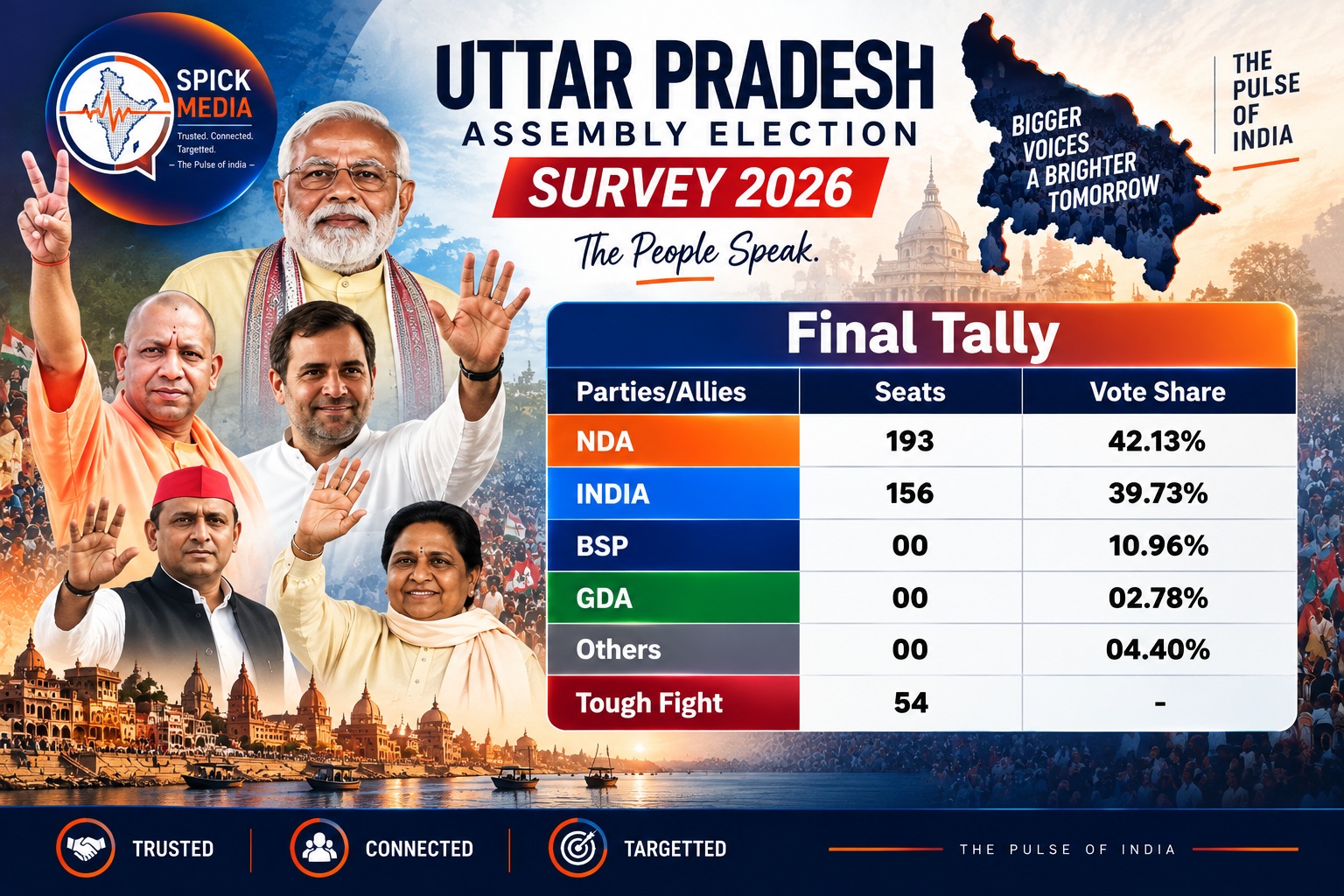
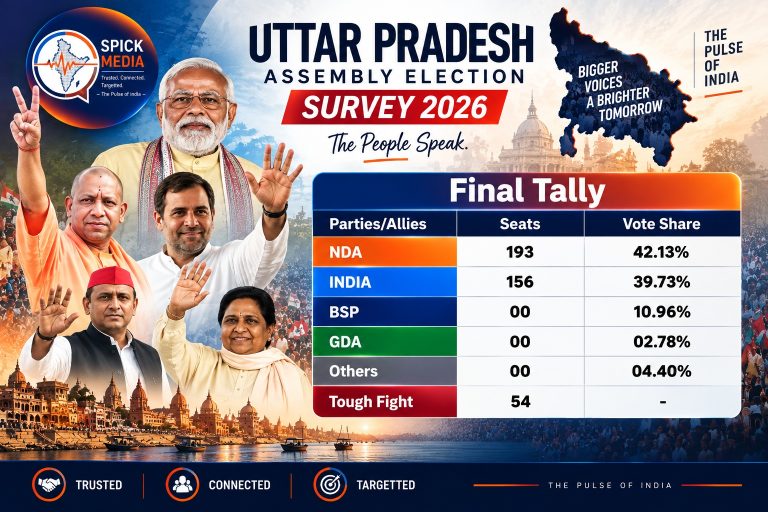
Spick Media Network’s extensive Uttar Pradesh Assembly Election Survey, covering 2,20,983 respondents, gives the BJP-led NDA an edge over the SP-Congress alliance, with the NDA projected to win 193 seats against 156 for the INDIA alliance.
The Pulse of Uttar Pradesh was conducted across Uttar Pradesh between
June 20 and August 6. The questionnaire was designed, conducted and analysed by Spick Media Network in both English and Hindi.
NDA ahead, but contest remains competitive
According to the survey, the
BJP-led NDA receives 40% support, while the
SP-Congress alliance (INDIA) receives 35%. BSP stands at 6%, while the GDA/Third Front gets 2%. Six per cent of respondents remain undecided, with another 8% giving no response.
When respondents were asked which political formation they believe has the best chance of forming the next government, the NDA was at
41%, followed by the SP-Congress alliance at
38%.
However, the survey also points to a closely contested political environment. When respondents were asked to choose between the two principal alliances in their constituency,
38% preferred the BJP-led NDA and 37% preferred the SP-Congress alliance, while BSP received 8%.
Seat projection
The constituency-wise assessment gives the following projection:
| Alliance/Party |
Projected Seats |
Vote Share |
| NDA |
193 |
42.13% |
| INDIA |
156 |
39.73% |
| BSP |
0 |
10.96% |
| GDA |
0 |
2.78% |
| Others |
0 |
4.40% |
The survey identifies
54 constituencies as Tough Fight seats, suggesting that a significant number of constituencies could remain highly competitive.
Yogi remains the preferred CM face
Despite the competitive electoral mood,
Yogi Adityanath leads the Chief Ministerial preference, with 33% of respondents choosing him as their preferred next Chief Minister. Akhilesh Yadav follows at 27%, while Priyanka Gandhi receives 10%, Mayawati 9% and Chandrashekhar Azad 7%.
Yogi also leads when respondents were asked which leader best understands the problems of ordinary people in Uttar Pradesh, with 30%, followed by Akhilesh Yadav at 23%.
At the same time, the survey reveals a mixed assessment of the Yogi government. While 45% are either completely or somewhat satisfied with its performance, 41% are either somewhat or completely dissatisfied.
Unemployment emerges as the biggest concern
Unemployment is the single biggest issue identified by respondents, with 19% naming it as the most important issue facing Uttar Pradesh.
Agriculture and farmers’ concerns follow at 14%, while inflation stands at 13%. Corruption is identified by 7%, while law and order and roads/infrastructure are each at 5%.
Jobs also emerge as the top priority for the next government, with 19% choosing employment as their first priority and 15% choosing agriculture.
The employment question could prove particularly important among younger voters. The survey finds that 38% believe getting a government job has become harder over the past five years, compared with 23% who believe it has become easier.
Farmers remain a crucial electoral constituency
Among farmers,
crop prices (15%), irrigation (13%), crop damage (13%), electricity (12%) and MSP (12%) emerge as major concerns.
The stray cattle issue also remains significant, with 52% describing it as either a very serious or somewhat serious problem in their area.
Caste continues to matter
Caste remains an important factor in the electoral landscape.
51% of respondents describe caste as either extremely or very important when deciding their vote.
The survey also finds that 26% believe the BJP’s broad Hindu/OBC/Dalit coalition is most likely to determine the 2027 election, followed by the SP’s PDA coalition at 20% and BSP’s Dalit coalition at 15%.
The community-wise responses also show distinct political patterns: BJP leads among Upper Castes, Kurmi/Koeri and Non-Yadav OBC respondents, while SP has a strong lead among Yadav and Muslim respondents. BSP leads among Jatav respondents.
BSP’s relevance under pressure
The survey suggests a challenging electoral position for BSP. While Mayawati remains the
most preferred Dalit political leader, with 28%, 29% of respondents describe BSP as “almost irrelevant” and another 18% say it is less relevant than before.
If BSP contests independently, 79% say they would probably or definitely not vote for the party.
At the same time, BSP’s presence could still influence the broader electoral equation, particularly in closely contested constituencies.
Alliance politics could be decisive
The survey indicates that alliances remain important to voters.
39% prefer a BJP-led alliance involving all NDA allies, while 35% prefer an SP-Congress alliance.
Importantly, 67% say they would either definitely or probably transfer their vote to an alliance partner if their preferred party gives the Assembly seat to that partner.
A divided opinion on change
The survey also captures a closely divided electorate on the question of government change.
41% believe Uttar Pradesh definitely or probably needs a change of government, while
44% believe the state probably or definitely needs continuation of the present government.
Among those favouring change, unemployment, inflation and farmers’ issues are among the leading reasons.
Among those favouring continuation, law and order, development and infrastructure are the strongest reasons.
The bigger picture
The
Pulse of Uttar Pradesh survey presents an electoral landscape where the BJP-led NDA currently holds an advantage, but the contest is far from one sided. The NDA’s projected
193 seats gives it the upper hand in the constituency wise assessment, while the
156 seat projection for the INDIA alliance underlines the strength of the SP-Congress combination.
At the same time, the survey identifies
54 constituencies as tough fights, suggesting that candidate selection, alliance arithmetic, local issues and voter movement could significantly influence the eventual outcome.
With unemployment, farmers’ concerns, inflation, caste equations, welfare and law and order all playing important roles, the survey indicates that the 2027 Uttar Pradesh Assembly election is likely to be shaped by
both state level governance and constituency level electoral dynamics.


Fantastic survey and Kudos to your team for covering this vast state,are you guys going to do second round after few months
Yes, we’re planning for a second round in the coming months. We’ll share more details once we finalize everything. Thank you for the support.